
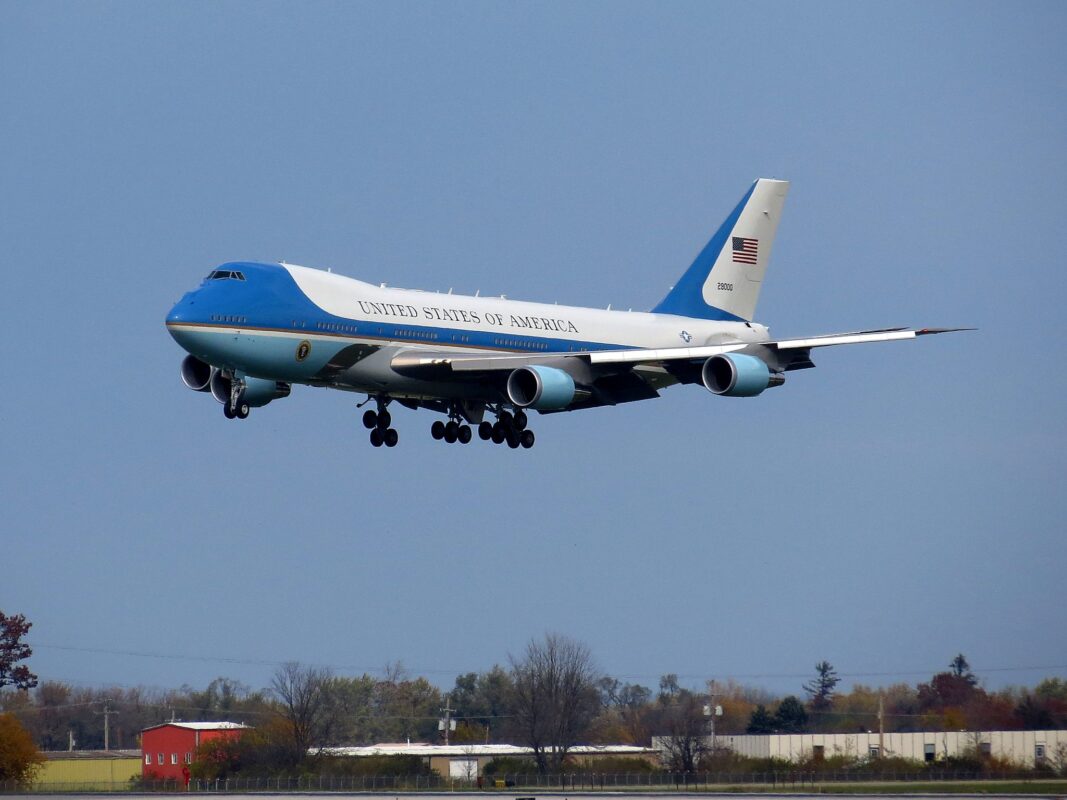

A late night mechanical hiccup briefly delayed President Trump’s trip to Davos, but the media frenzy that followed said far more about Washington dysfunction than it did about any real danger in the air.
Less than an hour after taking off from Joint Base Andrews on Tuesday night, Air Force One turned back to Maryland due to what the White House described as a “minor electrical issue.” According to press secretary Karoline Leavitt, the crew detected the issue shortly after departure and made the decision to return “out of an abundance of caution.” The plane touched down at 11:07 p.m. Eastern, and that was that.
Reporters onboard said the lights briefly flickered in the press cabin, which was enough for the usual breathless speculation to kick in. In reality, the protocol worked exactly as designed. No drama, no danger, just a safety call followed by a quick pivot to a backup aircraft.
President Trump boarded a replacement plane, an Air Force C 32, roughly an hour later and departed shortly after midnight. The C 32, a modified Boeing 757, is routinely used for presidential travel and got the job done without issue. The president was still on track to arrive in Switzerland in time to address the World Economic Forum in Davos early Wednesday morning.
Treasury Secretary Scott Bessent, already in Davos, told reporters Trump would arrive about three hours behind schedule. In classic fashion, Trump brushed off the delay before leaving Washington, telling reporters, “This will be an interesting trip. I have no idea what is going to happen. But you are well represented.”
What this episode really highlights is how outdated the current Air Force One fleet has become. The Air Force still operates two modified Boeing 747s that entered service in 1990. They were supposed to be replaced years ago, but delays have pushed delivery of the first new aircraft to 2027, with the second not expected until 2028.
That delay is not a mystery. Cost overruns, bureaucratic inertia, and endless contracting problems have plagued the program. President Trump has been openly critical of the situation, and last summer he confirmed that the Qatari royal family donated a Boeing 747 8 valued at roughly $400 million to eventually serve as Air Force One. Even that solution is not simple. Air Force Secretary Troy Meink has said refurbishing the aircraft to meet presidential security standards could cost several hundred million dollars.
So while critics rushed to spin Tuesday night’s turnaround into something ominous, the truth is far more mundane. A minor issue was identified, safety procedures were followed, and the president continued on his mission. If anything, the incident underscores how badly Washington needs to modernize critical assets instead of pouring money into pet projects and foreign aid.
President Trump made it to Davos, the world kept spinning, and Air Force One once again proved that caution beats panic every single time.

Leave a Comment