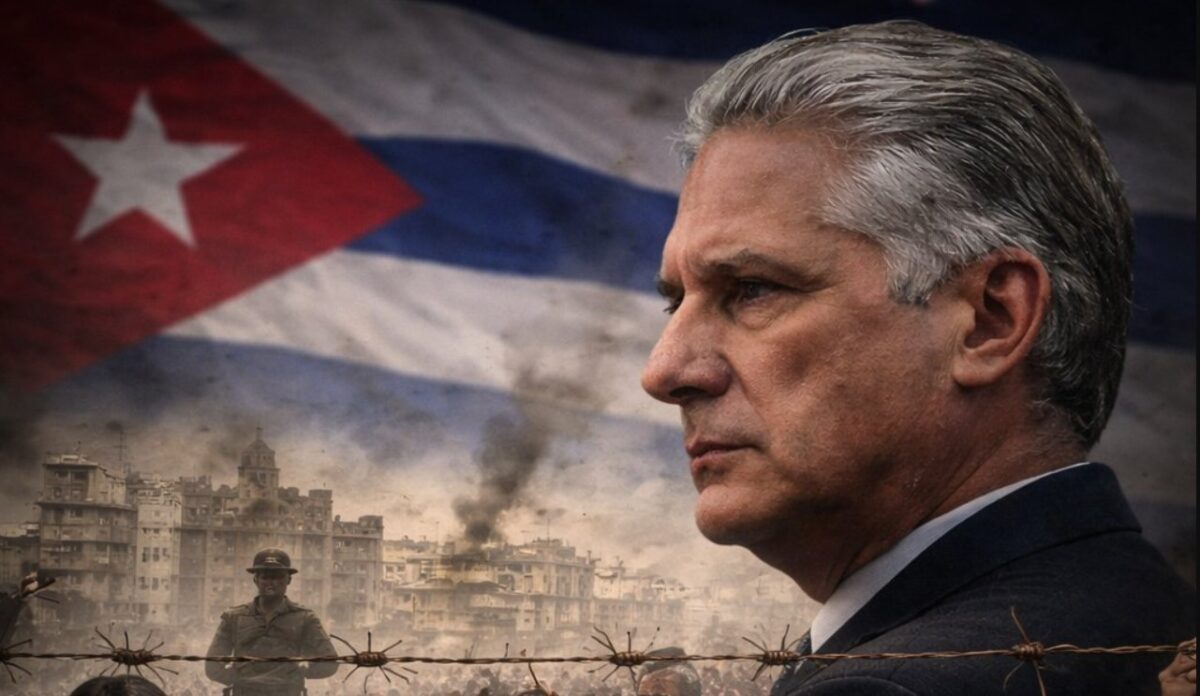

President Trump’s recent ultimatum to Cuba has ignited a fierce public response from Cuban dictator Miguel Díaz-Canel, underscoring rising tensions between Washington and Havana following the U.S. operation in Venezuela. Trump warned on Truth Social that Cuba should “make a deal” with the United States or risk being cut off from Venezuelan oil and financial support, a lifeline that sustained the communist regime for decades.
In his message, President Trump declared that there would be “no more oil or money going to Cuba – zero!” and urged the Cuban government to negotiate “before it is too late.” He framed the move as part of America’s strengthened position in Latin America after the capture of Venezuelan President Nicolás Maduro, emphasizing that the U.S. now serves as a protective force in the region.
“…THERE WILL BE NO MORE OIL OR MONEY GOING TO CUBA – ZERO! I strongly suggest they make a deal, BEFORE IT IS TOO LATE. Thank you for your attention to this matter.”- President Donald J. Trump pic.twitter.com/bHEIysJ7q1
— The White House (@WhiteHouse) January 11, 2026
Díaz-Canel responded defiantly to Trump’s threat, rejecting any notion that the United States could dictate Cuban policy. The Cuban leader took to X (formerly Twitter) to affirm that Cuba is “a free, independent, and sovereign nation” and insisted that no foreign power, including the U.S., has the right to impose terms on Havana. He framed the island’s struggles as the result of “draconian measures of extreme strangulation” by the United States over the past six decades, rather than internal mismanagement.
In strong language reminiscent of Cold War rhetoric, Díaz-Canel vowed that Cuba would defend its homeland “to the last drop of blood,” a phrase used to signal unyielding resistance and resolve. He portrayed Cuba not as the aggressor but as a nation under continuous U.S. aggression, reinforcing his view that external pressure will not break the regime’s will.
#Cuba es una nación libre, independiente y soberana. Nadie nos dicta qué hacer. Cuba no agrede, es agredida por EE.UU hace 66 años, y no amenaza, se prepara, dispuesta a defender a la Patria hasta la última gota de sangre.#CubaEsCoraje
— Miguel Díaz-Canel Bermúdez (@DiazCanelB) January 11, 2026
Officials in Havana have also clarified that there are no current negotiations with the U.S. government on Trump’s terms, aside from limited technical discussions on migration issues. Díaz-Canel stressed that any future diplomatic engagement must be rooted in mutual respect and international law, not coercion or threats.
This exchange highlights just how strained U.S.-Cuba relations remain, decades after the end of formal Cold War hostilities. With Venezuelan oil supplies effectively cut off after the U.S. intervention and Venezuela’s oil industry disrupted, Cuba faces severe economic challenges, including worsening energy shortages already exacerbated by years of sanctions.
While Trump’s ultimatum was designed to bring Cuba to the negotiating table, Díaz-Canel’s response shows a leadership unwilling to bend to U.S. pressure. The conflict reflects a broader geopolitical clash, and for now, Cuba’s defiance suggests the regime is in no hurry to acquiesce — even as economic hardships deepen and political isolation grows.
Leave a Comment