
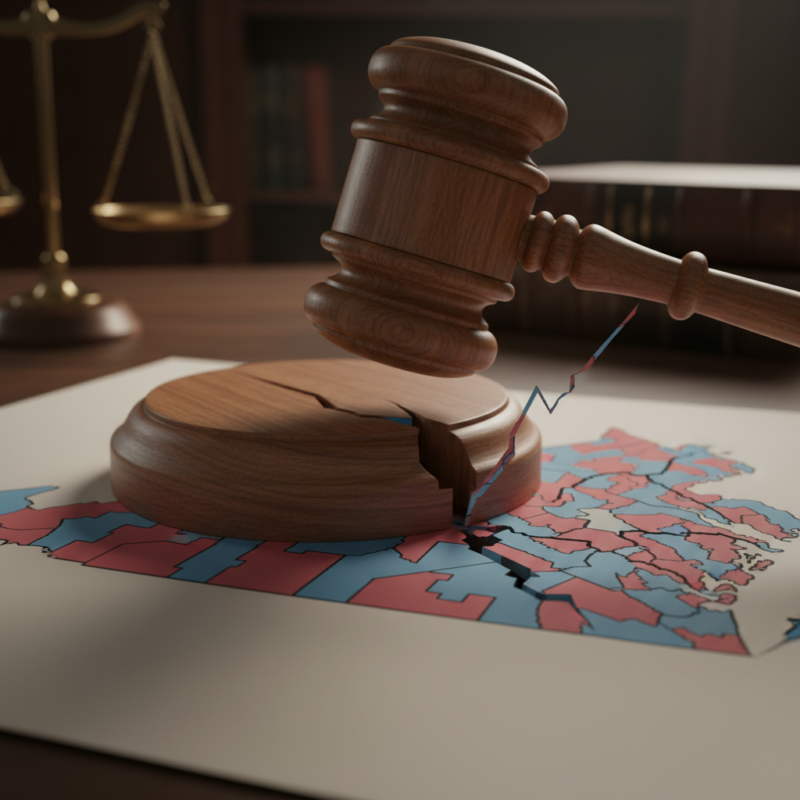

Virginia Democrats just ran headfirst into an inconvenient thing called the law, and a judge reminded them that power does not mean you get to make it up as you go. On Tuesday, a Virginia judge shut down a Democrat-led attempt to radically redraw the state’s congressional maps ahead of the 2026 midterm elections, a move that would have conveniently locked in one-party dominance.
Tazewell Circuit Court Judge Jack Hurley Jr. ruled that the proposed constitutional amendment pushed by the Democrat-controlled Virginia General Assembly was invalid. The amendment, rushed forward during a special session, would have allowed lawmakers to redraw congressional districts mid-decade, something Virginia law does not casually permit for obvious reasons.
Democrats only floated this idea after retaking control of the legislature and the governor’s mansion last year. Once they had the keys, they wasted no time trying to rewrite the rules. Under the proposed map, Democrats would have controlled 10 of Virginia’s 11 U.S. House seats. That is not representation, that is engineering. Nearly half of Virginia voters supported President Trump in 2024, yet the new map would have left those voters functionally irrelevant.
Under the current district lines, Virginia’s House delegation sits at a 6-5 split, a fair reflection of a politically competitive state. That balance was apparently unacceptable to Democrats who campaigned on fairness and transparency. Funny how those principles vanish the moment the math stops working in their favor.
Judge Hurley invalidated the amendment on procedural grounds, and the list of violations was not short. The legislature failed to follow its own rules for adding the amendment to the special session agenda. The proposal was not approved before voting began in the previous general election. It also was not published for public notice three months prior to the election, as required by state law. In other words, this was not a technicality, it was a mess.
This ruling followed an earlier January decision where Hurley declined to block the process midstream, citing separation of powers and the need to review final actions. Once those actions were final, the court did exactly what courts are supposed to do, apply the law instead of partisan wish lists.
The lawsuit was brought by Republican legislators who argued the amendment was invalid from the start. On Tuesday, they were proven right. The decision prevents the proposal from advancing to a voter referendum, meaning the 2026 elections will proceed under the existing maps drawn after the 2020 Census.
Democrat-aligned groups like Virginians for Fair Elections say they plan to appeal. They are free to try, but the clock is not on their side. Primaries, filing deadlines, and election logistics do not bend easily to political desperation.
This episode is a reminder. When Democrats talk about protecting democracy, what they often mean is protecting their margins. In Virginia, at least for now, the courts were not buying it.

Leave a Comment